New Yorkers are Excellent
I’m going home later this week. Maybe I can get a ride…

‘Member when I said I’d put out more movie lists this year? No. 2 coming your way. This is the list of eleven movies (yes eleven: this is a quirky list) you may very well have never heard of but which I quote regularly. See? You’ve been thinking I’ve been being a little free with the vodka when I yell out unrecognizable non-sequitor quotations, haven’t you? Well, you stand corrected. These aren’t classics or on any best lists but they’re excellent entertainment.

It’s January and that means it’s time for lists. Lists of last year’s bests, the last decade’s bests (which shouldn’t come out until the end of the new year, right?), resolutions for next year and the next decade, lists of all the things I didn’t do over the holidays, lists of things I could do instead of all those things, lists of how to make better, more effective lists.
I like lists but they’re tricky. For instance, over the holidays, two people – a teenager and a septuagenarian – asked me to provide a list of the top ten movies they should have seen. Those lists can’t possibly be the same, can they? I majored in film (roughly) in college and have seen far more peculiar and probably a broader range of movies than most people really should. Also, I have strong opinions about “good” and “better” and the canon in general, so I would seem to be a solid candidate for generating lists of things, especially directive lists.
Sadly, not so.
I sink early: do you want a list of the absolute best movies? Because you probably won’t like a lot of them and then you might take it out on me later when I’m trying to have a nice cup of coffee with you and you’re bent on revenge because I made you watch that bit where the weird man cuts the girl’s eyeball with a razor blade. What you probably mean, when you ask for “the movies I should have seen” is “the movies you think I should have seen that you think I will like.” Which is, as I’m sure you know if you think about it for a second, a very different list.
Or maybe you mean a list of my favorite movies, which are certainly not the best movies ever made or ones which you might enjoy and, unless you’re my therapist, will probably just confuse you. Then I’d have to provide explanations with each one about why it made the list so you don’t think I’m a standard-less idiot for loving French Kiss but not The Godfather.
Any of the above will expose me to censure. If it’s a list for just you and I choose titles you don’t like, you may very well end up thinking I don’t know you at all. If it’s a list of my favorites, you may end up thinking you don’t know me at all. If it’s a list of best overall, you will either lose respect for me because I omit a film you worship or you will think I am a snob/deranged/unfeeling because I include things you have not seen and, after you have seen them, wildly dislike.
See? It’s kind of a lose-lose for me. (Also clear: I’m a little neurotic. Just a little.)
It’s a new year, however, and we’ll soon have a small child to imprint with good taste, so I’m going to have to buckle down, channel my inner Harold Bloom and commit to some kind of canon.
Let’s start with a set you’ll find hard to judge: I’ll list the top ten movies I can think of right now that I saw at exactly the right time and to which I have irrationally attached myself. I guess that makes this my Top Ten Favorite Movies list. Of course, I reserve all available rights to change my mind immediately when I think of other movies I like, my mood alters, the weather alters or whatever else alters, so don’t get all worked up if I left something off: it might make the revisions round.
See? I told you: you think there’s something wrong with me now, don’t you? No Star Wars on there. No Godfather or Ghandi or Lawrence of Arabia. Remember though that a.) I’m a writer, so James Cameron and George Lucas types irritate me, despite their strides for the industry, and b.) these are the movies that have been important to me, not the ones I think have been important for a large population or the general advancement of cinema. Those are different lists.
On that subject, A.O. Scott wrote up an excellent piece in November here. Click through to his Movies of Influence list and Movies of Quality list. He’s pretty on-track, with the exception of Shrek on the former (what the what?!) and Gosford Park (possibly the most boring movie ever) on the latter.
At the very least, none of the above will bore you. Movies are supposed to entertain, after all, right? Right. So enjoy. Maybe I’ll produce a ton of lists in 2010 and you can wake up each morning and sputter into your coffee as you read through my Top Ten Bedspreads and Top Twenty Picks for UN Ambassador to Paraguay. It’ll be fun.
Now that we’ve established that I missed A Steady Rain, what did I see and, more importantly, of what I saw, what should you see?
Unless you see or read everything Nora Ephron produces or are an Eileen-Fisher-wearing, lunch-date-having, Upper-West-Side-living woman over 55, you can probably miss Love, Loss, and What I Wore.
I’m in the former group, mostly because of her non-fiction – her early essays, to be more precise – and some because of When Harry Met Sally and My Blue Heaven. In the last several years, Ephron’s writing has become more specialized to her demographic group (I Feel Bad About My Neck), which is unfortunate for me since I’m 30 years younger than she is, and she’s been doing a lot more collaborating with her sister Delia, which usually spells disaster (Bewitched, Hanging Up). This play – more of a reading, really – is a combo My Demographic / Delia project.
Briefly, a woman wrote a little book for her daughter and granddaughter about defining moments in her life and illustrated it with drawings of what she was wearing at the time. It got picked up by a publisher. Nora and Delia got their hands on it, did a bunch of additional interviews with women and turned it into a five-woman show. The actresses sit on-stage and read/perform from the script.
A couple of the stories – not from the book – are touching or have some unexpected twists (breast cancer, same-sex marriage), and the cast (which switches out monthly) is high-quality enough to keep the audience’s attention, but I doubt it would have been produced without the Ephron name attached. It’s the kind of thing you go to with your aunt after you’ve had an overpriced lunch uptown. I was the youngest person – woman, actually: I think I saw two men – in the theater by, I’d bet, fifteen years.
At the West Side Theater Downstairs. Tickets. Through October 18th with Tyne Daly, Rosie O’Donnell, Samantha Bee, Natasha Lyonne, Katie Finneran. If you’re going to go, I’d go between October 21st and November 15th to catch Jane Lynch in the group.
I made a half-hearted effort see Michael Grandage’s (Frost/Nixon) production of Hamlet, starring Jude Law (co-interview here), in London over the summer but, predictably, it was sold out, presumably to nannies and models.
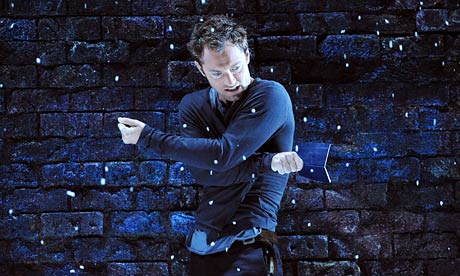
I’ve seen a lot of Hamlet, film and theater, but what’s one more? I was curious about how Jude Law’s charm would translate to a.) a Dane, and b.) a gloomy one, at that. His public shenanigans and the characters he picks (Alfie, Sky Captain, Dickie Greenleaf, Errol Flynn) share a self-absorption and good fortune that might make for an interesting Hamlet. That view was backed up by a quote he gave a reviewer about connecting with Hamlet because both he and Elsinore’s heir “know what it’s like to be misunderstood” or words to that effect, which betray both a lack of sophistication in managing the press and an adolescent sense of self, both of which Hamlet shares.
The production moved to Broadway last month (US interview and overview here), so off I went.
The word I’d use is “accessible.” Heavy on the crazy, light on the darkness, this is a good intro Hamlet. Not too much brooding, a lot of jumping around and an excellent reading of the text. Too often, even in practiced hands, antique language can slip by, passage after passage, with only the gist of the speech understood by half the audience. I’ve done the play: I’ve dug about with directors and dramaturges locating the original meanings of colloquialisms and out-of-use words, distinguishing them from the intentional enigmas of Hamlet’s madness. That comprehension can help an actor immeasurably, but it often stops there. The audience, unschooled, smiles and nods and misses out. Not so here. Well, not so for Hamlet’s part, anyway.
Law, flexible and agile, illustrates his words to very good effect, but something of Hamlet’s agony is lost with all the physicality. Who hasn’t read an article in Self or Men’s Fitness about how exercise improves the mood? Law’s Hamlet should, by rights, be surfing an endorphin high by the middle of Act I. Aside from that, time to think is at a minimum when Hamlet is manic, reducing the tragedy to the frame of, say, a runaway train rather than the more agonizing progress through layers of guilt, filial love, maternal betrayal, aimless youth, fate vs. intentionality, political position, and all the other issues more cerebral Hamlets contend with.
I can’t say I’ve seen the definitive Hamlet – is there one? – or even one I felt did all the angles justice. I dare say most people would agree, which is why the play is so obsessively produced. There’s no getting it all in. (If pressed, I’d say Kenneth Branagh’s uncut film comes closest to including all the angles, possibly because the text remained intact. Maybe because he had the best Horatio. Wish I’d seen Simon Russel Beale.)
So yes, it’s worth a viewing, although I’m not sure it’s worth $125. Take your teenagers or novice friends, if you have them.
Gertrude and Ophelia are unfortunately forgettable, as are Laertes and Horatio, and Peter Eyre as the Ghost/Player King delivers a truly awful performance in the worst tradition of classical theater – mumbling, rushing, overblown delivery in false stentorian tones – that grates disruptively against the accessibility of the rest of the production. Ron Cook as Polonius/the Gravedigger however is quite good, chipper and precise.
Donmar Warehouse production at the Broadhurst Theater, 235 West 44th Street, until December 6.
Tracy Letts’ new play, Superior Donuts, was never going to be August: Osage County, so it’s just as well he got it out of the way early.
For the record, August: Osage County is the best new play I’ve seen in my lifetime. I used to prevaricate on that point because it sounds like the kind of overstatement only idiots make, but, after further reflection, it is the fact of it so I’m going public with it. I went to Superior Donuts, then, as a general vote of support for Mr. Letts and knowing the play would be flawed. It’s just statistically unlikely you’d get two in a row and, as a working writer, I know it takes courage to plow ahead anyway. Write it, get it out there, move on.
Also, I have an irrational love of donuts.
The reason to see it is Jon Michael Hill. He plays France Wicks, the young, fast-talking black kid bringing new ideas to the aging donut shop run by Arthur Przybyszewski, played by Michael McKean. He’s the only reason to see it. He has the best lines, the best arc and delivers a performance that provides the play’s only heartbeat.
I was disappointed in McKean, but I’m pretty sure that’s a result of his limited options playing the tired, been there done that role of the aging hippie and his blah blah blah principles. I’m pretty well sick to death of the sixties and the self-righteous baby boomer ideals that all went to hell in the Reagan years anyway. Thank Oliver Stone, Tom Brokaw and the sheer volume – in numbers and noise – of that generation for talking so long and loud that there’s nothing interesting left to say about themselves and their awakening. I’m not clear what Letts was after in returning to that infertile ground.
What I can say for McKean is that he has almost teleportation level abilities to move around Manhattan. R and I ran into him on 73rd and Amsterdam not half an hour after the curtain came down. Of course, that’s not a reason to go see the play, but still impressive.
In sum, the play’s eminently missable, but I’m looking forward to the next one now that “The One After Osage” is sorted.
Music Box Theatre, 239 West 45th Street through, unbelievably and optimistically, March 28. Tickets here. Make sure you get the $49.50 deal.

I tried to scale back my manic theater-going schedule a bit this trip, after having marathon’d through far too many shows in far too few days the last time I was in New York. Five days. Three plays. Reasonable, right?
There’s this thing I do with tickets that’s very annoying. I know what plays are going up. I know which ones I will want to see. I know some of them are going to be popular and maybe sell out, so I…do nothing. The reviews come out, the general public joins the fray, some of the plays sell out and then I scramble to find seats. It’s like a twisted hobby I’ve adopted, like water skiing with one ski or kiteboarding with a bed sheet. Maybe it’s because I’m over-competitive and scoring seats doesn’t feel satisfying unless I’ve had to fight for them. Weird.
In this case, I’d had my sights set on A Steady Rain since the summer. Hugh Jackman and Daniel Craig in a new play by Keith Huff about two Chicago cops, a he said/he said drama.
Generally, I don’t like going to see shows with celebrities, especially ones without stage cred, because a.) they often suck, b.) I disagree, in principle, with giving plum roles to unqualified actors just so the producers can pay the Broadway bills (although I agree that bills need to be paid and, no, I don’t have an alternate suggestion), and c.) intermission is a hot mess of groupies misquoting the star’s latest movie and talking about how hot s/he is.
Lately though, there have been a number of serious plays produced featuring screen stars who do have backgrounds on the stage, so I’ve anted up. Waiting for Godot in London with Patrick Stewart and Ian McKellan this summer was excellent. The other Waiting for Godot in New York last spring with Nathan Lane and John Goodman was OK. God of Carnage with James Gandolfini, Hope Davis et al was a waste of time. Macbeth with Patrick Stewart in New York last year was unexpectedly weak. You win some, you lose some.
I wanted to see A Steady Rain on the strength of Daniel Craig, who had a successful stage career pre-Bond and is, by all accounts, very, very good. Hugh Jackman though is a wild card. He’s endearing, I’ll agree. Charming, yes. But he’s a musicals guy and that’s not usually a plus in a gritty drama. Plus, the play looked dubious and not up my alley, probably because I’m already saturated with CSI and Law & Order.
So I prevaricated on tickets. Our dates weren’t 100%. I tried to imagine Jackman, all bulked up from Wolverine, all smiles at the Oscars, toning it down for an intense tete-a-tete. I couldn’t. The show sold out.
Then, of course, I kicked into gear. I had to go. Tickets on eBay and Craigslist were going for $350-600. For a 90-minute, no-intermission show. Seriously? You would need to give me a Tony for that price. Or at least a full day at a spa with the massage administered by one of the stars. Maybe the three of us could get full-body waxes together.
I’ve had absurdly good luck scoring last-minute tickets this year, so I let it ride until we got to Manhattan. (Some research, some flexibility and a willingness to show up early and risk disappointment have yielded excellent results.) New York’s a busy place: someone was bound to have a scheduling conflict. Sure enough, face-value tickets for a matinee came up on Craigslist on Wednesday.
I didn’t buy them and I didn’t go.
Why?
Because Ben Brantley at the Times said exactly what I thought he might – weak play, weak Jackman, annoying audience. Because life is short and money’s tight. Because I’m perverse or edgy or just a New Yorker: when something’s wildly popular, it makes me want it less. Because life is short and I’m trying not to do any more things just to say that I did, just because they’re there just so I don’t theoretically regret not having done them.
So there.
Until next time, James Bond.
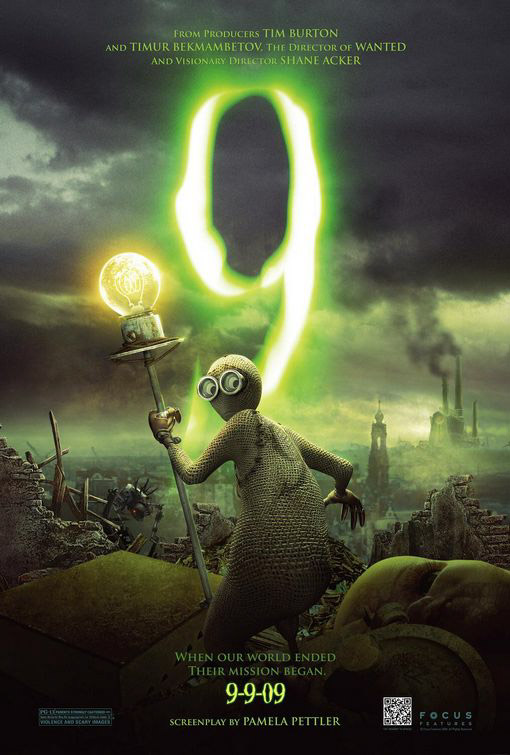
Just to be clear, I’m talking about 9, the movie about little burlap people making their way in a post-apocalyptic world of scary machines, not Nine, the movie about big-busted women making their way through Fellini’s anti-apocalyptic world of surreal parties. I can feel a burlap bachanal mash-up coming on when the latter gets released later this fall, but for now, we’re just going to chat about the former. A plot device of the latter to be specific. A plot device that drives me completely insane to be even more specific.
What plot device is that? The one where the “hero” does something unbelievably stupid that serves to set in motion a terrible string of consequences from which he (usually he) then “saves” the rest of the characters/the world for which he is then, in a mindbending perversion of cause and effect, rewarded. We, the gullible audience, are supposed to not only forgive him but embrace him because he has recognized his error and because he “makes up” for his stupid, stupid mistake.
There’s a category for that kind of incompetence in the business world: it’s called “grounds for dismissal” and, to my mind, it should be more liberally applied in the world of fiction.
Don’t get me wrong, I’m all for personal growth, even in tiny people made of hessian, but it strains my sense of justice that the guy who, however accidentally, caused the death of more than half of the remaining population of the planet not only keeps his job but gets promoted and lives out his days as the sole male in a tiny harem of little cloth ladies. What the hell is up with that?
Mistakes happen, sure. People are flawed, absolutely. Regrettable but true. But I’d rather watch a plot driven by a more complicated confluence of events and, yes, mistakes, than a plot driven by someone tripping on their shoelaces and setting off an atomic bomb. Although, actually, that might be entertaining. Let me try again: someone playing with the fuse on an atomic bomb and then acting like it wasn’t his fault when it goes off ’cause he “didn’t know”, and then “saving” the remaining world and getting the girl.
What happened to the step where you pay your debt to society for killing a bunch of people and screwing everything up for everyone else because you couldn’t be bothered to stop and think in the first place? It’s like a little tiny Bush Administration and it makes me nuts.
It’s the age of Obama, little burlap dude: time to man up and accept responsibility for your actions. In the meantime, the smart ladies can be in charge. They’re the ones who were running the joint before you came along anyway. Plus they’re made out of cotton and have better hats, so case closed.
“I’ve always believed that because you have access to people’s minds and communicate to people that there is a corresponding responsibility: the responsibility of being a good citizen and also recognizing that if you have the ablity to transfer ideas from one point to another that those ideas should cause no harm.”
– Milton Glasser
This is exactly what I was getting at when I wrote about the upsetting irresponsibility of District 9. So there.
Simon: It’ll be easy peasy lemon squeezy.
Toby: No, it won’t. It’ll be difficult, difficult lemon DIFFICULT.
Take a note District 9: ditch the aliens, find a kick-ass script and a swearing Scotsman and you’ll get further with that whole ‘lessons learned from apartheid/war mongering/being jerks’ thing.
(You’re going to hear me saying “lemon difficult” a lot from now on. Just fair warning.)

It’s a rare thing for me to walk out of a movie. I can only remember skipping out three times, which is saying something since I was a film student and had to sit through hundreds of screenings of marginal, odd and foreign films on top of the usual number of recreational trips to the cinema.
I dropped out of Unforgiven due to overwhelming boredom with massive male self-involvement. I’ve left A Streetcar Named Desire no less than five times. (It’s Marlon’s muttering. And the self-created southern drama. Maybe if I were southern it’d mean more. Or if I weren’t already busy with my own self-created northeastern drama.) I can’t remember the third one – I think it was something R and I went to by mistake so maybe it doesn’t count. Let’s drop Fame into that slot. My dad took us to that when we were little and ushered us out after the first blast of nudity. I don’t know what he thought we were going to see. Maybe an Andrew Carnegie documentary?
District 9 joined that motley crew on Thursday. I had a bad feeling going into it: I don’t particularly like sci-fi unless it’s ironic or big Hollywood, in which case it’s BYOI*. From what I read, District 9 also seemed like a tricky set-up: it’s filmed like a documentary, it’s meant to be an allegory, but really it’s an alien action flick. That sounded to me like trying to pass off aspic as Jell-O. The bright green food coloring you used made me think it was a low-cal American dessert but in fact it’s made from gelatinized meat and tastes like what you find at the bottom of a swamp. You gotta know I’m going to have an issue with that, and, lo and behold, I did.
In brief, the aliens arrive over Johannesburg but instead of being aggressive, they’re starving refugees. The South Africans set them up on the ground in – what else? – a refugee camp called District 9 which rapidly becomes a slum complete with little kid aliens digging through piles of garbage, alien-human violence and a lot of weapons-for-catfood bartering. (That last one doesn’t seem to be a hallmark of most slums I know about, but presumably it’s a marker for something less ridiculous like rice or heroin.)
A Blackwater stand-in is assigned to relocate the aliens to another camp and, in the process, one of the manager’s arms is injured and – Sigourney Weaver‘s tank top! – turns into an alien claw which is capable of firing the heretofore-aliens-only weapons the refugees brought with them. Hilarity ensues.
We didn’t leave because the plot was so heavy-handed but because of my issues with violence. It’s not just that I can’t stomach graphic violence, it’s that I have a moral objection to it. To my mind, the more realistic the violence you depict, the greater burden you assume for its effects. Fictionalizing human rights abuses is a messy business: you run the risk of making them less horrifying and more digestible because, “It’s just a story.” The shock value of real abuses – the photos from Abu Ghraib, for instance – is blunted when the public has been fed a no-consequence Hollywood diet of similar scenes. The non-fictional atrocities that happened in the slums outside Johannesburg during apartheid are, needless to say, diminished by projecting them onto subhuman, unsympathetic, catfood-eating aliens.
(Yes, Michael Bay and Co. have collectively killed far more henchmen and villagers and jungle-based mercenaries than Neill Blomkamp (District 9‘s director) has killed refugee aliens. I don’t love that ridiculous and clearly fictional violence either and it presents its own set of problems, namely, “Is exposure to ludicrous and improbable killings the first step toward dulling audiences’ senstivity to more realistic and disturbing material?” but as long as the general reaction to those movies’ liberties with the laws of reason and physics is, “No f’ing WAY!” I don’t think they pose as serious a threat of corruption as the face-to-face violence of films like District 9.)
District 9 has been promoted and reviewed as an allegory, a fiction of a non-fiction. Setting aside that I very much doubt that 90% of the largely young and male audience picked up on the connection to real events because of the vast gap between reality and fiction in this case, that form has a long and respectable history in the arts: if you can’t get the public’s attention with reporting and documentaries, try the multiplex. Fine. But in the same way that a biopic has a greater responsibility and a steeper climb because it’s depicting a real person, so too must a film about real events try its damndest not to glorify the worst elements of the story to reap greater box office rewards. Neill Blomkamp didn’t rise to that responsibility. As a result, District 9 is rife with stomach-turning violence that feels pointless instead of pointed. I didn’t need to stay for the second half of the film to endorse that failure.
So, in case you missed it, that’s a thumbs down from me.
*Bring Your Own Irony

The trip to Venice was – how shall I say this? Let’s go with “chaotic.” Beautiful, impressive and chaotic.
I’ll get into the chaos another time; first, let’s talk about the Guggenheim. The Peggy Guggenheim Collection was on the top of my list of things to see in Venice, right after “as much Palladio as possible”, but we didn’t get there until the afternoon before we left. In fact, I was so afraid we wouldn’t get there (because others – who shall remain nameless – were dragging their feet) that I felt the need to add a small motivational tantrum to the mix. I don’t know if it helped, but it seemed in keeping with Ms. Guggenheim’s eccentricity.
The collection is in Guggenheim’s gorgeous house which fronts on the Grand Canal but looks nothing like most of the surrounding Venetian palazzos: it’s white, it’s angular and it’s modern, modern, modern. (Not that I’d be averse to living in one of those other palazzos, mind you. If you’re offering, I’m in.)

At the ticket counter, I saw the directions to the special exhibition space and – hooray! – they’ve got Robert Rauschenberg’s series Gluts for the summer. Have I mentioned how much I love Robert Rauschenberg? No? Well, allow me: I love that man. I also love that when I saw him speak at the Guggenheim in New York, he was wearing a flaming pink dress shirt. Not an, “I’m comfortable with my masculinity,” pink, but an, “I could pass for a yard flamingo,” pink.
I fell for Rauschenberg at the Guggenheim’s retrospective in New York in 1997. I joined the museum that year, even though I was a pauper, so that I could get the exhibition catalog and go back to meet Rauschenberg at the reception (and by “meet” I mean, “look at from the first floor while he spoke in the lobby.”)
I loved the Combines the most, constructions of found materials (including, infamously, a stuffed goat), original paintings, recycled print, and photography. A close second was the amazing Hiccups, a set of 97 segments of handmade paper printed with images and zippered together. The constructions struck me as imaginative and somehow dynamic (literally, in the case of Hiccups, which can be rezippered in any configuration). Rauschenberg seemed…happy, I guess. Curious. Conflicted, but funny, not tortured. His work noted what was going on around him not by representing it or reducing it, but by collecting it. It felt like he saw what other people missed – junk, goats, discarded newsprint, tires – and accepted it all into his work without shying away from its grime or rust, elevating it to notice by recycling it.
(Slideshow overview of some of his work, including that goat, here.)
A few years later, the Whitney bought Synapsis Shuffle, another moveable work. Rauschenberg created fifty two 9.5′ panels (each 5′ or less wide), each its own piece of art. When it came time to show it, he’d collect a set of people – mostly famous, all from different walks of life – and stage a lottery. Each person drew a set of two numbers: the first indicating how many panels they’d get and the other a rank denoting in what order they’d be able to select their panels. Then they’d construct what they liked from their panels or barter with the other participants to get different panels.
I love the flexibility of that idea. Every time it shows, it’s different but it’s still absolutely that same work underneath. It’s done – for now and until the next time it’s done.

(The New York Times write-up here and a good piece on it in W here.)
Gluts is a series of sculptures (for lack of a better word) produced from the mid-eighties until Rauschenberg’s death last year. The Guggenheim Collection is exhibiting a fraction of the huge series. Over twenty-odd years, Rauschenberg pillaged junkyards for materials – twisted bumpers, discarded signs, bits of wrought iron metalwork – took them back to his studio and constructed these pieces – some enormous, some small – a testament to glut, to overproduction and the abandonment of the resulting goods. The pieces are a criticism and a resurrection all in one, a whimsical and substantial response to the issue.
(An excellent virtual tour through the exhibition here. A good, albeit very flatly lit, set of images from Gluts here.)
The standing collection at the Guggenheim house is wonderful as well. I love museums of personal collections – the Frick in New York and the Isabella Stewart Gardner Museum in Boston are two of my other favorites. For me, there is something intimate and human in visiting a personally curated collection that is very different from visiting a professionally curated exhibition in a museum. There are always lovely surprises among the selections and combinations.
The Rauschenberg is up through September 20th.
__________________________________________________________
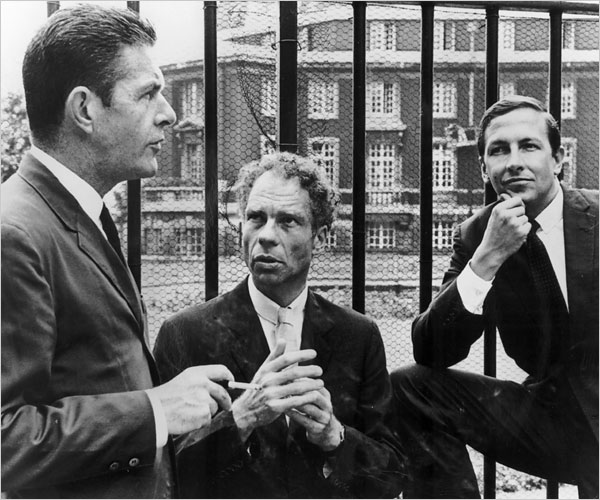
Incidentally, how good looking and cheerful was Rauschenberg? Lord, almighty. Check out this great picture of him (far right) with John Cage and Merce Cunningham from the Times‘ Cunningham retrospective. Also, this Avedon photo – currently up at SFMOMA through the end of November – of him with Alex Hay.
Apparently, he’s also a great father.


 Humor of the Week Read of the Week Delicious Links
 Displaced